




Northwold Manor Reborn: architecture, archaeology and restoration of a derelict Norfolk house

Northwold Manor Reborn: architecture, archaeology and restoration of a derelict Norfolk house, Warwick Rodwell with Diane Gibbs, Oxbow Books, 2024, 324 pages, 392 illustrations, hardback.
This book tells the fascinating story of the rescue of a derelict listed building at great length and in meticulous detail. Northwold Manor fronts onto the high street of a small linear village in Norfolk immediately opposite the medieval church. It is a complicated building of various dates. The principal structure is a symmetrical brick house dating from the mid-17th century of five bays with a central entrance and a projecting rear wing. It is flanked at one end by a taller brick wing with a pedimented entrance tower dated 1814. A separate flint cottage at the other end was linked to the main house later in the 19th century.
The manor was last occupied as a principal residence in 1955 before passing through the hands of a sequence of property speculators and developers before it was purchased in 1963 by a London-based architect who had previously prepared plans for its total demolition. He subsequently moved to Africa and the house became a repository for immense amounts of decaying second-hand furniture purchased by his wife at local auctions. Over the next 20 years, despite the offer of a grant from English Heritage and pressure from the Norfolk Historic Buildings Trust, the abandoned house gradually declined into total dereliction to become one of the most threatened buildings at risk in the country and was featured on the front page of the annual report of SAVE.
In 2003 the local authority issued a repairs notice which was ignored by the owner, and it was only a decade later that the subsequent compulsory purchase order, backed up by an agreement with the buildings trust, came into force. However, the estimated cost of restoration by now was so high that the trust was forced to withdraw.
It was at this crucial stage that Warwick Rodwell and his wife Diane Gibbs were looking for a home in East Anglia to retire to. With heroic courage they agreed to step in and buy the property once the CPO had been confirmed. There was one further hitch when the owner challenged the CPO through a judicial review. When this failed, they finally completed their purchase in 2014. Rodwell and Gibbs have spent the best part of the following decade in an exemplary restoration project, which has been characterised by the unforeseen challenges brought about by the lockdowns of the Covid-19 pandemic and the unprecedented rise in the cost of building materials.
As one would expect from one of our most eminent archaeologists, Rodwell began his daunting task with the detailed background research that he considered essential to his understanding of the building in formulating his approach to its restoration. The book begins with an analysis of the historic development of the village and the relationship of the Manor House to its surroundings, followed by chapters which give a detailed architectural history of its fabric, and its various owners and occupants. These three chapters take up a third of the book, and although Rodwell’s research is crucial to all that follows, his conclusions could have been summarised more briefly for the general reader.
It is only when he turns to the decline of the estate and the battle to preserve it that the book really comes alive with a chronological account of the course of the restoration. It is a testament to the value of meticulous research at every stage of the lengthy process, explaining not only the interventions that they took to make the house habitable again, but also the appropriate decoration of every room and the making of a worthy garden setting. They have created something totally unique and, in the relentless pursuit of their vision, they have also given us some charming autobiographical insights.
Rodwell functioned as his own architect and project manager throughout, using local craftsmen as required rather than employing a main contractor. All of them are individually acknowledged by name in an appendix. Nearly 400 photographs, mostly in colour, illustrate the progress of the work and illuminate their achievement in creating a home to accommodate their unique lifestyle. A notable feature is their painstaking attention to the interior decoration, which has helped to provide a home for Rodwell’s obsessive collection of period objects from salvage yards throughout the country.
A necessary addition to the house was the creation of a library wing on the footprint of a vanished orangery to house their enormous collection of books. Architecturally it is seamlessly integrated with the house externally, and internally it is graced by book presses designed in 1841 by C R Cockerell for Queen’s College, Oxford, and rescued at the outset of the project. Their busy professional lives demanded that they should have separate studies, and independent access is gained by an octagonal staircase tower in the East Anglian tradition, which forms a distinctive feature of the garden elevation.
The book concludes with a personal chapter in which Rodwell reflects on what he calls his ‘manorial odyssey’. Having shared their journey through the pages of this book, the overriding emotion is amazement at their bravery in embarking on it in the first place and a profound admiration for all they have achieved. As Ptolemy Dean comments in his lively foreword, ‘… it is one of the most remarkable historic building rescues of modern times.’
By their involvement, Northwold Manor has indeed been saved when it once seemed impossible. More important, its future has been secured by the intention of Rodwell and Gibbs to leave it as a gift to a charitable trust so that it can be enjoyed by future generations. It will come with an exemplary record of their professional approach and selfless determination in the form of this book.
This article originally appeared as ‘Manorial odyssey’ in the Institute of Historic Building Conservation’s (IHBC’s) Context 183, published in March 2025. It was written by Malcolm Airs, past president, IHBC.
--Institute of Historic Building Conservation
Related articles on Designing Buildings Conservation.
IHBC NewsBlog
IHBC sponsors Gardens Trust event 23-4 Sept 2026
.jpeg)
'Learning from the Past, Shaping the Future’ takes place in Milton Keynes
Renovations to Frank Lloyd Wright's Fallingwater complete
.jpg)
World Heritage Preserved project opens house for tours again
Shakespeare Birthplace Trust places Hall's Croft on HAR Register
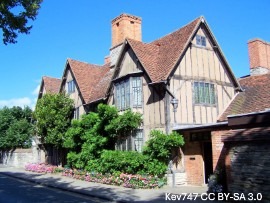
Stratford-upon-Avon home of Shakespeare's daughter is 'At Risk'
Lady Grange’s House repaired on St Kilda
.jpg)
National Trust for Scotland repairs stone cleit with link to famous island resident
Griff Rhys Jones on BBC Radio 4 Today programme
,_Green_Lane,_Derby.jpg)
The Victorian Society’s President unveiled its latest Top Ten Endangered Buildings 2026.
Need a MATE? Book your place now.
IHBC offers free webinars on applying for IHBC accreditation (Full & Associate).
UK Stained Glass Repository finds windows new homes
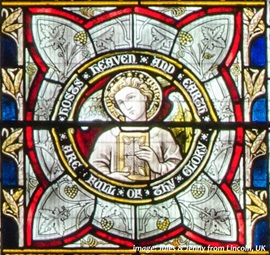
How are stained glass windows are rescued, stored and repurposed?
APPGEBE report sets high aims for quality
'Government must not sacrifice quality in drive to build 1.5m homes'
New measures protect Historic Shipwrecks from heritage crime

Underwater cultural heritage benefits from new HE guidance
How could the City of London skyline look in 6 years' time?

Visualisation shows approved planning applications as completed buildings
National Trust for Scotland calls for VAT cuts
Heritage neglect is encouraged by current policies
IHBC's 'Context' Issue 186 features Industrial Heritage
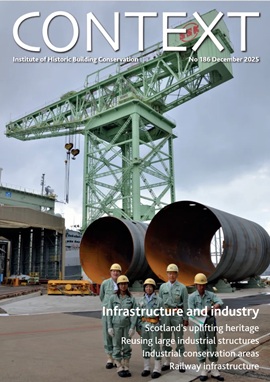
IHBC's members' journal reports on the challenges of conserving infrastructure
Book now for IHBC Annual School 2026

IHBC Annual School is taking place 18-20 June 2026 in Newcastle
RICHeS Research Infrastructure offers ‘Full Access Fund Call’
RICHeS offers a ‘Help’ webinar on 11 March
Latest IHBC Issue of Context features Roofing
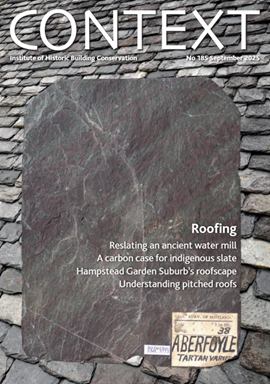
Articles range from slate to pitched roofs, and carbon impact to solar generation to roofscapes
Three reasons not to demolish Edinburgh’s Argyle House

Should 'Edinburgh's ugliest building' be saved?
IHBC’s 2025 Parliamentary Briefing...from Crafts in Crisis to Rubbish Retrofit
IHBC launches research-led ‘5 Commitments to Help Heritage Skills in Conservation’
How RDSAP 10.2 impacts EPC assessments in traditional buildings

Energy performance certificates (EPCs) tell us how energy efficient our buildings are, but the way these certificates are generated has changed.